
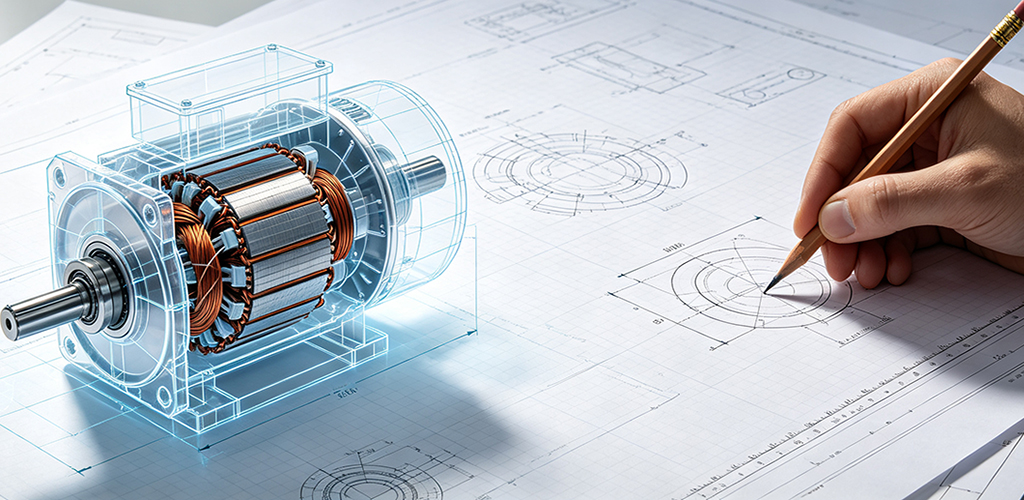
The pump motor is the heart of any coffee machine. Two types of pump motors are commonly used: vibration pumps and vane pumps (also referred to as rotary pumps). Vibration pumps are typically found in home coffee machines, while rotary pump motors are the preferred choice for office and commercial coffee machines. Let's take a closer look at the features of rotary pump (vane pump) motors for coffee machines.
I. Rotary Pump Mechanism
A rotary pump, as its name implies, uses rotational motion to transfer liquid. In a coffee machine, it draws water from the tank and delivers it to the coffee grounds at a consistent, stable pressure to extract the full flavor and aroma. The rotary pump also functions as a pressure-regulating device, allowing the machine to maintain precise control over brewing pressure. The pump mechanism includes a pulley and a hydraulic unit: as the pulley turns, the hydraulic system adjusts the pressure to the desired level.
II. Pressure Regulation Principle
A typical rotary pump consists of a shaft, a rotor, a stator, and sealing components. As the motor spins the rotor, the chamber volume between the rotor and stator changes cyclically, creating both vacuum and pressure. The pressure regulation works through the pump's rotation: when the coffee machine is turned on, the rotary pump activates, and the spinning pulley moves a threaded rod that fine-tunes the pressure. Once the rod reaches the position that matches the required pressure, the machine is set to the ideal extraction pressure. Inside the rotary pump, fan-shaped vanes work with the motor's rotation to build pressure quickly and smoothly — capable of raising low-pressure water to the 8–10 bar range needed for perfect espresso extraction. Even if the incoming water is not pressurized, the pump can self-prime and maintain stable extraction pressure. This pressure differential draws water in through the inlet and pushes it out through the outlet. The pump must maintain a steady, consistent pressure to ensure that brew time, extraction quality, and flavor are always at their best.
III. Advantages of Rotary Pumps
Rotary pumps offer several key benefits:
1.Stable pressure: The built-in pressure regulation automatically maintains consistent output, ensuring reliable performance in all conditions.
2.Lower noise: Precise pressure control contributes to better flavor extraction, and while rotary pumps are larger and more costly, they run much quieter than alternatives.
3.Longer service life: With a simple, robust design, the rotary pump is highly durable. The separated motor and pump head make maintenance easy. Extraction pressure can be manually adjusted, and the pump remains reliable even with low or no inlet water pressure.
Overall, the coffee machine rotary pump (water pump motor) is a stable, reliable, and easy-to-operate pressure-regulating device. It plays a vital role in the coffee brewing process and is an important component worth understanding for coffee enthusiasts. It is primarily used in commercial semi-automatic coffee machines or large commercial fully automatic coffee machines.
Donghong Electromechanical offers two main customized solutions for office/commercial coffee machine pump motors:1.C9455 AC induction motor. 2.BLDC60 brushless DC motor. The C9455 AC induction motor features capacitor-start operation, delivering 300W high power, high torque, low noise, low cost, and a medium-to-long service life.The BLDC60 brushless DC motor shares the same advantages as the C9455, while offering additional benefits including lower heat generation, support for extended continuous operation, an ultra-long service life (exceeding 20,000 hours), and stable performance (with Donghong's matched driver solution). Both motors are fully capable of meeting the demands of office coffee machines and large commercial fully automatic coffee machines.